Translate

Don't miss
Showing posts with label tech. Show all posts

Tuesday, January 12, 2016

About Power Bank and its Helpful Tips


A power bank is essentially an external battery in a sealed case. Powerbanks come with a USB cable; you connect it to a power source such as a laptop to charge the powerbank. Some charge via flip out blades for plugging into the wall. Here are more information about this wonderful gadget;

1) What’s power bank?
Power bank serve as an ‘extra battery’ or external charger for your phone or other electronic devices.

2) Where is power bank made from?
Majority of the power banks in the market are actually made in China.

3) How do I charge the power bank?
You can charge your power bank via the charger that came with your phone, computer usb port or using other power bank

4) How long do I need to charge the power bank?
It’s depending on the REAL CAPACITY of the power bank. The larger REAL CAPACITY, the longer charging time may required. Different charging methods may result different charging time as well. Charging with the original charger will be faster than charging with computer usb port.

5) Why sometime I need longer time to charge the same power bank?
Even though using the same charging method, the charging time may be differ due to environment,temperature, power flow and etc

6) What is mAh?
mAh mean milli Ampere Hour, the capacity of the power bank is measure with mAh

7) A 12000mAh REAL CAPACITY power bank, able to charge a 1500mAh capacity phone for 8 times full?
This is a common mistake make by most of the people. For rough calculation of the total charge time, kindly use this formula
REAL CAPACITY * conversion rate * phone battery health / phone capacity = total charge times
EXAMPLE: 12000 x 0.8 x 0.8 / 1500 = 5.12 charge times (0.5-1 times plus minus)

8) What’s conversation rate?
Conversation rate is the remaining percentage of the battery after the battery lost in heat or PCB operation.

9) What’s phone battery health?
In simple, it’s mean how‘healthy’ your phone battery is. Phone battery storage capacity will be lower and lower. That’s also the reason why our phone can last longer when it’s newly bought than after 3-6 months we used it. Different mobile phone models also will affect the calculation as some phone drain battery faster than the other.

10) What’s PCB?
PCB means Printed Circuit Board,its control all the operation flow inside the power bank. A good quality PCB will allow the power bank to charge more and have better durability

11) What’s 18650 power bank and what’s Li-Polymer power bank?
The common type will be 18650 and a better type will be Li-Polymer

12) What’s the different between 18650 and Li-Polymer?
- 18650 size and dimension are fix. Li-Polymer size and dimension are flexible.
- 18650 produce more heat. Li-Polymer are much more safer
- 18650 are cheaper. Li-Polymer are more expensive
- 18650 have higher self discharge rate.Li-Polymer have a very low self discharge rate
- 18650 battery durability will drop faster.  Li-Polymer battery capacity are more durable

13) What’s the common mAh use in 18650?
Common mAh use in 18650 is around 1300mAh to 2200mAh.

14) What’s the common REAL CAPACITY in 18650 power bank in the market?
- Power bank using 1pcs 18650 is 1200mAh – 2600mAh
- Power bank using 2pcs 18650 is 2500mAh – 4400mAh
- Power bank using 3pcs 18650 is 3750mAh – 6600mAh
- Power bank using 4pcs 18650 is 5200mAh – 8800mAh
- Power bank using 5pcs 18650 is 6500mAh –11000mAh
- Power bank using 6pcs 18650 is 7800mAh –13200mAh
- Power bank using 7pcs 18650 (no info)
- Power bank using 8pcs 18650 is 10400mAh –14400mAh

15) Is there any power bank use higher than 2200mAh per 18650?
Yes. There are, but it’s not common due to the expensive pricing.

16) What’s the different between branded power bank and generic power bank?
Branded power bank mostly sell in REAL CAPACITY. Generic power bank mostly sell in MARKING CAPACITY. That’s the reason why you will never see any branded power bank (standard size) have anything as high as 30000mAh – 50000mAh. That’s also the reason why a good 12000-13000mAh power bank are able to charge more or about the same like the market 30000-50000mAh power bank

17)  Is it true branded power bank won’t explode and generic power bank will explode?
Anything to do with battery, will have chance to explode. No matter it’s branded power bank or generic power bank.But chances for both branded and generic power bank to explode are near to 0%.If power bank is easy to explode, everyone will use power bank in war instead of bomb.
Source: Styefree Asia fb.

Wednesday, October 7, 2015

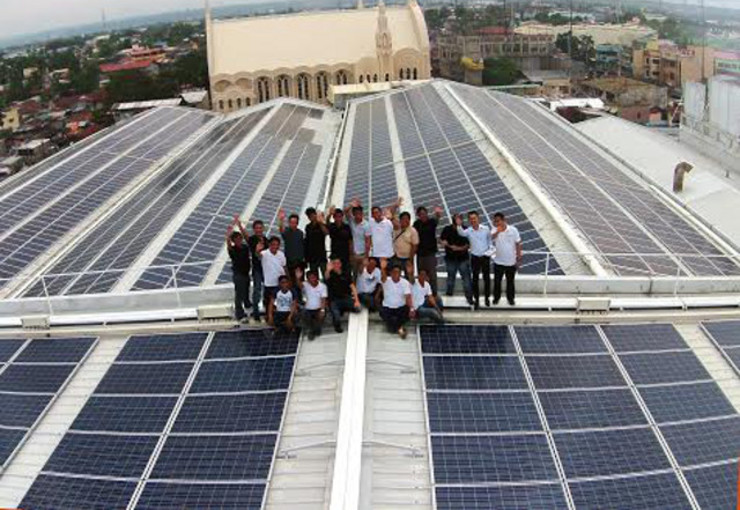
20 Malls install Roofs with Solar Panel


Solar panels will line up roofs of at least 20 malls come next summer, generating about 30 megawatts (MW). 

The  1.5 megawatts of electricity produced by the solar panels at the roof top of SM North Edsa was enough to power 16,000 lighting fixtures and 20 escalators enabling SM to save P2 million per month in electricity bill.

The power generated  from the SM North Edsa  project can offset 1,200 tons of carbon dioxide equal to planting 6,000 trees per year. 

Leandro Leviste, Solar Philippines chief executive officer, said the solar panels in the malls will show people that solar energy is commercially viable. 

“Between Robinsons, SM and some other large malls we should have around 20 malls finished by maybe next summer. The mall installations usually (have a capacity of) 1 megawatt each so I estimate that it would add up to 30 MW,” said Leviste.

He said Solar Philippines is almost done installing the solar power system with a capacity of 2.7 MW on the rooftop of the parking building of the SM Mall of Asia which is targeted to be operational within the month.

“That is more of a showcase to be seen by the millions of people that (frequent) SM Mall of Asia to raise awareness that solar energy is commercially viable. We also have four under construction with Robinsons and many more in the pipeline with them,” Leviste added.

In the past year, among the mall projects completed by Solar Philippines were the 1.5 MW rooftop power plant in SM North EDSA, 1.2 MW in Robinsons Place Palawan, 0.7 MW in Central Mall Biñan in Laguna and 0.6 MW in CityMall Roxas.

Solar Philippines is not yet looking at solar projects in off-grid areas.

“We’re focusing on where we can make the largest impact and scale before going to markets like off-grid and then residential afterwards. Right now, all developers are focused with the feed-in-tariff (FIT),” Leviste said.

Aside from solar rooftop installations, the company is also engaged in the development of various solar power plant projects vying for FIT including the 70 MW in Calatagan, Batangas and a 40 MW solar farm in a still undisclosed area in Mindanao. 

Only energy projects that can produce power before March 2016 can qualify for FIT and become entitled to 20 years of fixed rate of P8.69 per kilowatt hour. 

FIT-certified projects will also be given preference in the dispatch in the Wholesale Electricity Spot Market.

Records of the Department of Energy show as of the first half of the year, the country’s total grid installed capacity from solar projects is at 110 MW or 0.60 percent of the total mix.

Source: http://www.malaya.com.ph/

Wednesday, February 4, 2015

Yahoo Mail vs. Gmail...Your Choice?


Why to switch from Yahoo Mail to GMail?

GMail edges out Yahoo! Mail because of its speed and spam blocking. Yahoo! has too much spam, including IM span. Also POP access and disposable addresses require paid account. Here are some reasons why you need to switch from Yahoo to Gmail;


  • Faster access to mails and general speed in sending & receiving mails. Powerful search function for e-mail similar to Google. Filtering out e-mails with .exe attachments possible.
  • Better spam blocking and less spam. Yahoo has too much spam including IM spam. Yahoo! also sucks to differentiate b/w legitimate and spam mails.
  • Automatic forwarding for GMail.
  • Supported E-mail client access for GMail:POP3, IMAP, SSL/TLS supported, SMTP restricted. Yahoo supports only POP3 that too for certain regions. (This feature is to be noted as it's useful in the article)
  • Gmail localization for 52 languages, Yahoo 27 languages
  • GMail has text ads only in viewing mail box, not in messages. Yahoo has ads in interface and mails.
  • Domain name customization possible in GMail using Google Apps
  • Custom From address can be set up in GMail
  • Address modifiers available in GMail (userid followed by + followed by tag)
  • IE, Firefox, Chrome, Opera only compatible with new version of Yahoo Mail.
  • Account expiration on inactivity 9 months in Gmail that too at Google's discretion vs 4 months for Yahoo Mail.
  • Other special features in GMail: Messages grouped into conversations, Basic HTML view gives faster access for slower net connections, Labels are used in GMail instead of folders in Yahoo.
Source: Techsupport.com

Friday, January 23, 2015

DOTA banned


The popular computer game DotA (Defense of the Ancients) was banned in Barangay Salawag in Dasmariñas, Cavite following an ordinance implemented by the local government there.

In a report from GMA's “24-Oras” on Wednesday, Salawag Bgry. Captain Eric Paredes said someone already died due to the computer game.

“Mayroong dalawang namatay na ang pinagmulan ay sa mga computer shop nang galing 'yung pag aaway. Nalamin namin na ito pala'y naglalaro ng games sa computer shop at isa nga dito 'yung sinasabi nila na DotA,” Paredes said.

Aside from this, barangay officials said DotA distracts youngsters from their studies and is a bad influence that makes the youth participate in video game gambling and violence.

Violators of the resolution passed by the Sangguniang Barangay last Monday will be subject to up to 2 months of suspension for the first offense.

Computer shops caught for the second offense will be closed while those who violate the law for a third time will be revoked of their barangay business clearance.
Maricel Navarette, a parent and resident of Salawag strongly suppoted the ordinance.

“Tama lang din na ibawal para yung kabataan ay medyo makapag concentrate sa pag aaral nila. Minsan yung iba ang baon nila itatabi nila para lang pang DotA nila,” Navarette said.

But Marlon Quistadio, a regular DotA player who now finds contentment in watching DotA matches in YouTube after the ban believes otherwise.

“Para sa akin po hindi naman po nakakasama yung pag DodotA kasi parang ito na lang po yung libangan ko lang,” Quistadio said.

At least thirty computer shops were inspected by authorities in Barangay Salawang following the recent implementation of the ordinance.
Source: GMA News

Monday, September 15, 2014

Popular Social Networking Sites


1 | Facebook
3 - eBizMBA Rank | 900,000,000 - Estimated Unique Monthly Visitors | 3 - Compete Rank | 3 - Quantcast Rank | 2 - Alexa Rank | September 1, 2014.
Twitter2 | Twitter
12 - eBizMBA Rank | 310,000,000 - Estimated Unique Monthly Visitors | 21 - Compete Rank | 8 - Quantcast Rank | 8 - Alexa Rank | September 1, 2014.
LinkedIn3 | LinkedIn
18 - eBizMBA Rank | 255,000,000 - Estimated Unique Monthly Visitors | 25 - Compete Rank | 19 - Quantcast Rank | 9 - Alexa Rank | September 1, 2014.
Pinterest4 | Pinterest
22 - eBizMBA Rank | 250,000,000 - Estimated Unique Monthly Visitors | 27 - Compete Rank | 13 - Quantcast Rank | 26 - Alexa Rank | September 1, 2014.
Google+5 | Google Plus+
30 - eBizMBA Rank | 120,000,000 - Estimated Unique Monthly Visitors | *32* - Compete Rank | *28*- Quantcast Rank | NA - Alexa Rank | September 1, 2014.
Tumblr6 | Tumblr
34 - eBizMBA Rank | 110,000,000 - Estimated Unique Monthly Visitors | 55 - Compete Rank | *13* - Quantcast Rank | 34 - Alexa Rank | September 1, 2014.
Instagram7 | Instagram
77 - eBizMBA Rank | 100,000,000 - Estimated Unique Monthly Visitors | 49 - Compete Rank | 145 - Quantcast Rank | 36 - Alexa Rank | September 1, 2014.
VKontakte8 | VK
97 - eBizMBA Rank | 80,000,000 - Estimated Unique Monthly Visitors | *150* - Compete Rank |*120* - Quantcast Rank | 21 - Alexa Rank | September 1, 2014.
Flickr9 | Flickr
123 - eBizMBA Rank | 65,000,000 - Estimated Unique Monthly Visitors | 138 - Compete Rank | 139 - Quantcast Rank | 91 - Alexa Rank | September 1, 2014.
Vine10 | Vine
581 - eBizMBA Rank | 42,000,000 - Estimated Unique Monthly Visitors | 237 - Compete Rank | 335 - Quantcast Rank | 1,172 - Alexa Rank | September 1, 2014.
Meetup11 | Meetup
596 - eBizMBA Rank | 40,000,000 - Estimated Unique Monthly Visitors | 791 - Compete Rank | 701 - Quantcast Rank | 296 - Alexa Rank | September 1, 2014.
Tagged12 | Tagged
702 - eBizMBA Rank | 38,000,000 - Estimated Unique Monthly Visitors | 1,082 - Compete Rank |615 - Quantcast Rank | 408 - Alexa Rank | September 1, 2014.
Ask fm13 | Ask.fm
779 - eBizMBA Rank | 37,000,000 - Estimated Unique Monthly Visitors | 2,046 - Compete Rank |113 - Quantcast Rank | 179 - Alexa Rank | September 1, 2014.
Meet Me14 | MeetMe
1,457 - eBizMBA Rank | 15,500,000 - Estimated Unique Monthly Visitors | 1,407 - Compete Rank |635 - Quantcast Rank | 2,328 - Alexa Rank | September 1, 2014.
Classmates15 | ClassMates
1,487 - eBizMBA Rank | 15,000,000 - Estimated Unique Monthly Visitors | 153 - Compete Rank |*285* - Quantcast Rank | 4,022 - Alexa Rank | September 1, 2014.
Source:  eBizMA

Monday, August 25, 2014

Goggle builds faster Internet


Frustrated by the hammerlock of U.S. broadband providers, Google Fiber starts with a connection that is up to 100 times faster than today's average broadband speeds. Google Inc. has searched for ways around them to provide faster Internet speeds at lower cost, via everything from high-speed fiber to satellites.

In the process, it is changing how next-generation broadband is rolled out.

Telecom and cable companies generally have been required to blanket entire cities, offering connections to every home. By contrast, Google is building high-speed services as it finds demand, laying new fiber neighborhood by neighborhood.

Others including AT&T Inc. and CenturyLink Inc. are copying Google's approach, underscoring a deeper shift in U.S. telecommunications policy, from requiring universal service to letting the marketplace decide.
As Google's model gathers momentum, it stirs up questions about whether residents of poor or underserved neighborhoods will be left behind.

U.S. policy long favored extending service to all. AT&T touted its "universal service" in advertisements more than a century ago. The concept was codified in a 1934 law requiring nationwide "wire and radio services" to reach everyone at "reasonable charges."

In exchange for wiring a community, telecommunications providers often gained a monopoly. Cities made similar deals with cable-TV providers beginning in the 1960s.

The emergence of the commercial Internet in 1990s led to a reassessment. Policy swung in favor of encouraging competition in the hope that it would bring more people online faster. Over time, Congress and regulators loosened the strings on Internet providers.

Google seized the opening in 2010, as it sought to stoke demand for bandwidth-hungry businesses, such as its YouTube online-video site. It solicited interest from cities for a new network, specifying that it sought "opportunities to experiment with deployment techniques." More than 1,000 municipalities responded.

In 2011, Google struck a deal with authorities in both Kansas City, Kan., and Kansas City, Mo., to build the service based on customer demand. City officials say they didn't push hard for universal coverage because they thought faster Internet service would boost the local economy and they were competing against so many other cities.

"The main point was to win and bring that infrastructure to our city," said Rick Usher, assistant city manager of Kansas City, Mo.

As phone and cable companies slowed their own expansion plans, more cities allowed the selective approach.

Mary Beth Henry, director of community technology in Portland, Ore., says broadband providers balked at covering the entire city. So Portland stopped requiring universal coverage in 2007 and this year signed a deal with Google that employs the build-to-demand approach.

Offering service everywhere is "too risky and returns are lower," she said.

In Kansas City, Google divided the region into areas of a few hundred homes it called "fiberhoods" and asked residents to pay $10 to preregister for a service that would operate at one gigabit per second, about 100 times the U.S. average. The service now costs $70 a month.

If interest exceeded a certain threshold, generally between 5% and 25% of households, Google connected the area. The threshold varied based on population density. Google also worked with local officials to speed the permitting and construction process. It skipped some areas entirely, because they were too thinly populated or because of construction challenges, a company spokeswoman said.

To date, Google has conducted preregistration in 364 neighborhoods; all but 16 hit Google's threshold for connection. Google hasn't disclosed how many homes in each neighborhood subscribe to its service.
A survey earlier this year of five neighborhoods in the Kansas City area conducted for brokerage firm Bernstein Research found that more than half of households had signed up for the service. At that rate, the service would be "very profitable" for Google, Bernstein analyst Carlos Kirjner said.

The Bernstein survey found that participation varied with income. In the Wornall Homestead neighborhood—median household income $116,000—83% of residents surveyed subscribe to Google Fiber; in the Community College area—median income $24,000—27% subscribe.

The flexibility to choose where to build, more efficient construction techniques and cheaper components mean it costs Google about 20% less to reach a home compared with Verizon Communications Inc. VZ +1.05% 's FiOS high-speed service, according to Bernstein estimates.

Kevin Lo, general manager of Google Fiber, said the build-to-demand approach is crucial for making the business work, but said Google isn't cherry-picking the best neighborhoods or ignoring poorer areas. Of the city's 20 lowest-income areas, he said 19 qualified for Google's fiber service.

Still, concerns persist that Google is exacerbating the "digital divide" because its service may be more common in well-off areas. That is more important as more day-to-day services shift online, such as applying for jobs.

Installing fiber only where there is most interest "leaves out every city's most vulnerable citizens," said Michael Liimatta of Connecting for Good, a Kansas City nonprofit that focuses on digital divide issues.
To address these concerns, local officials required Google to offer free service to schools, libraries and community centers, said former Kansas City, Kan., Mayor Joe Reardon, who worked on the initiative during his tenure. Google agreed to offer service in "economically distressed" neighborhoods and offers a slower service that is free for seven years, after a $300 installation fee.

But Mr. Liimatta and others think those steps aren't adequate. "It is too early to say whether the stuff Google is doing is enough," said Angela Siefer, who researched these issues this year for the University of Illinois's Center for Digital Inclusion. "Being friends with Google is great, but you have to go further to address these issues."

Some cities resist the selective approach. Los Angeles last year solicited plans for gigabit fiber networks to reach every home, business, education institution, government office and nonprofit in the 466-square-mile city. Sixteen companies responded last month, including AT&T, Time Warner Cable Inc., International Business Machines Corp. and Alcatel-Lucent.

Google didn't respond, said Steve Reneker, the city's chief technology officer. A Google spokeswoman said the company is focusing on its networks in Kansas City, in Austin, Texas, and Provo, Utah, and the 34 others it hopes to enter.

Verizon was required by cities and some state laws to build and offer its FiOS service widely across cities. It stopped expanding to new cities in 2010; to date, it has spent more than $23 billion on the FiOS rollout. Chief Financial Officer Fran Shammo said in March that the company wouldn't expand to additional markets until FiOS had "finally returned its cost of capital."
If Verizon resumes expansion, the company would consider Google's build-to-demand model because it has the potential to be more profitable, said Chris Levendos, a Verizon executive overseeing the FiOS build-out in Manhattan.

Others are doing just that. AT&T said in April it would offer Internet speeds of up to one gigabit in as many as 100 cities. It is building to demand and working with local authorities to reduce construction costs, the company said. Tuesday, it said it would bring the high-speed service to Cupertino, Calif., close to Google's headquarters.

This approach "starts to make this business model look quite attractive," John Stankey, AT&T's chief strategy officer, said at an investor conference on Aug. 13.

In North Carolina, AT&T also agreed to provide free service for seven years for up to 100 community centers, though cities or outside groups will have to pay connection costs.


CenturyLink this month said it plans to offer one-gigabit Internet service in Portland, and 15 other cities. CenturyLink will choose where to offer the service based on usage patterns of existing customers.