Translate

Don't miss
Showing posts with label business. Show all posts

Thursday, April 7, 2016

Suntech Ipark taps Globe as ICT Partner


Property Company of Friends Inc., (Pro-Friends) remains a trailblazer in the Philippine real estate industry with its newest master-planned 25-hectare commercial, business and lifestyle township community called Downtown Lancaster, located right in the heart of the 1,400-hectare Lancaster New City in General Trias, Cavite.

Downtown Lancaster is composed of two major developments: Suntech iPark and The Square. Suntech iPark is Cavite’s first BPO office development which will house 17,500 BPO employees, while The Square is the commercial and retail section that will complement the needs of Suntech iPark and nearby residences. Downtown Lancaster will be delivered in phases: Phase 1 will cover the construction of four BPO buildings and seven retail buildings while Phase 2 will be the development of the remaining seven BPO buildings and ten retail buildings.

With this major development, Pro-Friends has turned to Globe Business, the information and communications technology (ICT) arm of Globe Telecom and preferred ICT partner of the country’s top BPO companies, for its connectivity requirements, specifically for its wireline data services. Globe Business is expected to provide secure, fast, and cutting-edge connectivity for thousands of BPO employees as well as the different commercial and retail establishments in Downtown Lancaster.
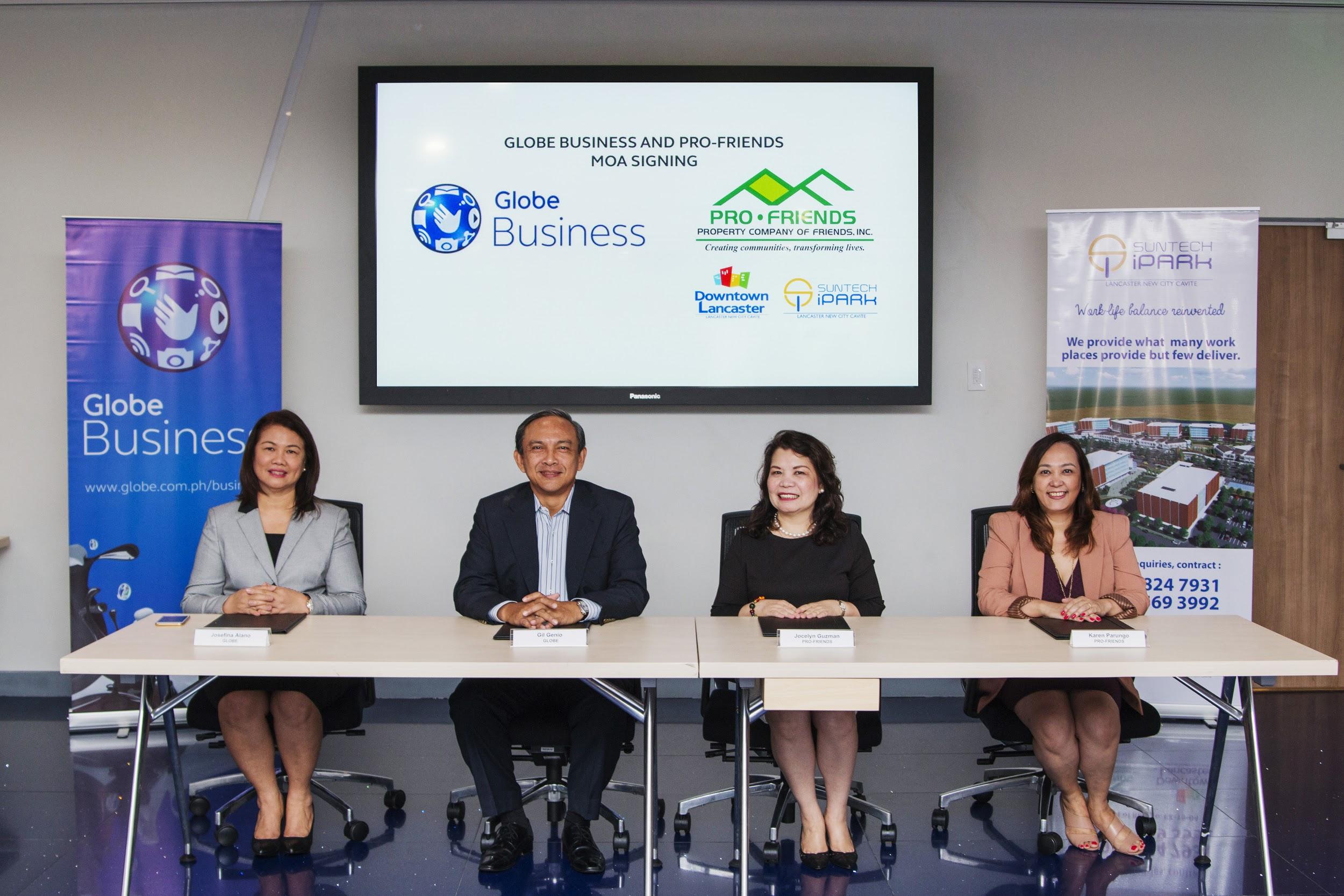
Formalizing the partnership between Globe and Pro-Friends are Globe Chief Technology and Information Officer Gil Genio (2nd from the left) and Pro-Friends Senior Executive Vice President Jocelyn Guzman (3rd from the left). With them are Pro-Friends New Projects Development Head Jessie Alano (leftmost) and Pro-Friends Vice President for Commercial and Retail Development Karen Parungo (rightmost).
Formalizing the partnership between Globe and Pro-Friends are Globe Chief Technology and Information Officer Gil Genio (2nd from the left) and Pro-Friends Senior Executive Vice President Jocelyn Guzman (3rd from the left). With them are Globe New Projects Development Head Jessie Alano (leftmost) and Pro-Friends Vice President for Commercial and Retail Development Karen Parungo (rightmost).
“We put our trust in Globe Business because we believe that our employees and retail tenants will experience reliable and seamless service,” shared Pro-Friends Vice President for Commercial and Retail Development Karen Parungo. “We are very excited for the partnership and we look forward to the different ways Globe Business can help improve our operations.”

Globe Chief Technology and Information Officer Gil Genio noted that enterprise customers will soon benefit from the company’s network transformation program, which is set to modernize its wireline data network. “Customers like Pro-Friends which is expanding to build a BPO hub in Cavite will definitely experience connectivity that is up to par with first-world countries, as we embark on another infrastructure build that will enhance the internet experience within homes and businesses.”

In 2015, Globe Business has driven the revenue growth of leading Business Process Outsourcing (BPOs) companies in the Philippines based on statistics by Call Center Focus. It has served the country’s top IT-BPO companies, seven of which were in the top 10 earners in terms of revenue in Philippine peso (Php) Billions. In addition, Globe Business also recorded an 81% penetration of IT-BPO companies that are provided with business products and solutions.
Source: Business Inquirer

Wednesday, March 30, 2016

GT Capital raises stake in Profriends


GT CAPITAL Holdings, Inc., the holding company for tycoon George S.K. Ty’s businesses, is raising its stake in mass housing developer Property Company of Friends, Inc. (PCFI) starting this year.


GT Capital President Carmelo Maria Luza Bautista said in a mobile phone message last week the conglomerate will exercise its option to increase its direct ownership in the real estate firm to 51%.

“The plan is to increase first to 42% within the first half of the year and then to 51% by the first quarter of next year,” Mr. Bautista said.

In August last year, GT Capital signed an agreement to acquire 22.68% of PCFI for P7.24 billion, subject to closing conditions, with an option to boost its stake to 51% within the next three years.

Profriends Group, Inc., which was planning on undertaking a P7.7-billion initial public offering (IPO), owns 98.51% of the issued and outstanding capital of PCFI, an affordable housing firm.

Asked if PCFI will pursue the IPO, Mr. Bautista said: “Not in the near future.”

Based on its previous filing, Profriends was planning to sell 385.750 million primary common shares, representing 11% of the company’s outstanding capital stock, at maximum price of P20 apiece to finance the development of its projects and land banking initiatives.

Profriends obtained the approval of the Securities and Exchange Commission (SEC) to launch the equity offering, but failed to secure the go-signal from the Philippine Stock Exchange (PSE).

Profriends had tapped First Metro Investment Corp. (FMIC) as its underwriter for the IPO. FMIC is the investment banking arm of Metropolitan Bank & Trust Co., which is part of GT Capital.

PCFI netted P2.1 billion last year after booking P7 billion in total revenues. GT Capital started consolidating its financial performance in September.

“GT Capital’s recent acquisition of PCFI further expands the group’s range of products and market presence in the property development sector,” Federal Land, Inc. Chairman Alfred V. Ty said in a statement last week.

Aside from Federal Land and Metrobank, GT Capital has interests in Toyota Motor Philippines Corp.; Toyota Manila Bay Corp.; Toyota Cubao, Inc.; Toyota Financial Services Philippines Corp.; Global Business Power Corp.; Philippine AXA Life Insurance Corp.; and Charter Ping An Insurance Corp.

The conglomerate reported a 32% uptick in bottomline to P12.1 billion last year from P9.2 billion in 2015, driven by the strength of its automotive and power generation businesses.

Shares in GT Capital added P16 or 1.12% to close at P1,450 each last Wednesday.
Source: Business World


Thursday, November 5, 2015

Housing Project brings jobs for residents


Every Filipino visiting Tokyo should nurse an envy at the sight of a metropolis so well governed.

I frequented this city many times in the past. Each time I visit, the city seems to be cleaner and more efficient.
Tokyo has about the same population as Metro Manila, although it is easy to imagine her population shuffles about more intensively than people do here. The reason is simple: they can.
As a victim of Manila’s horrendous traffic jams, it was a thrill last week to actually go to four separate places in Greater Tokyo between lunch and dinner. In Manila, one can no longer have four appointments in different places in one afternoon.
Even during rush hours, traffic moves in Tokyo. The reason for this, apart from a thoroughly developed subway system, Tokyo just kept on building elevated expressways crisscrossing the metropolitan area. In many places, there are as many as four decks of elevated roadway in this city.
Five days in this city, I have not seen a single traffic enforcer. There is simply no need for them in a place where everyone so scrupulously observes the rules.

Even in small alleys, there are pedestrian stoplights. Needless to say, they, too, are scrupulously observed.
No one smokes in the streets of Tokyo these days. One may smoke only in specifically designated cubicles equipped with air filters.
No one litters in the streets of this city – not because there are stiff fines as in Singapore but because that is the right thing to do. Notwithstanding, the streets are washed every night.
Tokyo sets a high standard for how a metropolis ought to be governed. Future infra needs are anticipated and set in place before congestion happens. The Japanese are proud of their trains, and for good reasons. Japan Railways reports a cumulative delay of only a few seconds for all its train services each year. A breakdown in the rail system, which happens regularly with the MRT, will be a national scandal soothed only by the resignation of the top rail officials.
Because this is such a well-governed metropolis, productivity is imaginably high. Urban efficiency and high productivity constitute a virtuous cycle. The key to that is the quality of governance provided.
Metropolitan Manila and Metropolitan Tokyo are on two ends of the spectrum of urban governance. A four-hour flight took me from one extreme to the other.
The descent back to the Third World was quick. Back at the Manila airport, I saw passengers wrapping their baggage in duct tape to protect from thieves and extortionists. Phone calls dropped. Internet service was slow. The streets were grimy. Governance remains substandard.
Close to midnight, traffic was still at a crawl. I looked at the forlorn faces of commuters unable to get a ride. I knew I was home.  

Townships

If Metro Manila had a reliable rail service, it would be easy for much of the city’s working population to live out of the city.
An efficient rail system explains why there are few high-density housing complexes within Metropolitan Tokyo itself. Because Metro Manila failed to build an efficient mass transit system, the trend here is towards high-rise, high-density mass housing. Meanwhile, the urban transport system remains primitive, producing the traffic nightmare we now endure daily.
Since we are not about to build a comprehensive mass transit system in the foreseeable future, the next best solution to the problem is to build townships that are as self-contained as possible. One such township is the Lancaster New City now being built over 1,107 hectares in Kawit and General Trias in Cavite province. The Property Company of Friends or Pro-Friends is engineering this sprawling project.
For years, our housing developers have been building low-cost housing projects in the provinces surrounding Metro Manila. The economists at Pro-Friends, however, realized that people who buy in these housing developments continue to commute to the city for work, spending a large bulk of their income on transportation.
The Lancaster New City, with its scale, is planned to attract BPO companies to its property development so that jobs will be available to people who invest in housing in the community. BPO companies, after all, are trying to disperse out of the city to bring down costs and attract more talent.
With jobs brought closer to the homes, residents will now be spending less on transport and more for raising their quality of life. This is, no doubt, an attractive proposition for those wishing to flee the infernal traffic jams in the metropolitan area.
Pro-Friends, with this project, sets a new standard for property development. The challenge now is to build economically self-sustaining communities, reducing the need to travel to work and reducing the carbon footprint for residents.
It is an attractive proposition for me to be sure, considering how much gas I consume daily and how much exasperation I endure getting to and from work. It will be an attractive proposition for the younger generation seeking lifestyles with a smaller carbon footprint.
This economically contained township concept will have to be planned on a certain scale. It is a project scale that requires robust financing.
Fortunately for Pro-Friends and their ambitious township project, a large banking conglomerate found the idea of a self-contained community an attractive and viable one. This banking group took out a stake in Pro-Friends, bringing the Lancaster New City development several steps closer to completion.
With our banking system now able to finance large developments in a lower interest rate environment, it should be possible to replicate this township concept elsewhere.
Source: Alex Magno - http://www.philstar.com/

Friday, October 9, 2015

Cybercrime Law put to First Tests


THE country’s newly minted Cybercrime Law may soon be tested. Word on the street is that a mass housing developer is contemplating filing online libel charges against those behind what it calls “vicious Internet and social media attacks” on its projects.


While the developer—Pro-Friends—has yet to file what could be an important precedent-setting case against those using Internet platforms like YouTube, Facebook and Twitter to disparage it, the firm has already set the ball in motion.

Pro-Friends, in fact, won round one of its effort to combat a “syndicated effort” to destroy its reputation when the Regional Trial Court of Mandaluyong City issued a warrant for the arrest of several persons for grave slander and oral defamation.

Interestingly, one Biz Buzz source pointed out that there’s a force associated with the family of a realtor-politician behind the concerted attacks on Pro-Friends, so business rivalry could be the root of this issue.

If this is true, to whom does the hidden hand behind the defamatory campaign against Pro-Friends belong?

In fact, what Pro-Friends calls a “demolition job” against it has been going on for sometime now. The property firm believes it isn’t a spontaneous outpouring of protest by disgruntled clients, but rather a “well-funded and orchestrated by unseen hands who want to run the property development company to the ground so they can have a monopoly of the market.”

“The black propaganda campaign has been stretched by hiring ‘professional protesters’ to mount lightning mass actions complete with placards carrying libelous slogans against Pro-Friends,” said one source familiar with the reality firm’s side of the issue.

If rumors are to be believed, this developer politician has even used his political power to initiate investigations in both houses of Congress to pressure Pro-Friends, supposedly in a bid to cripple its marketing program—all while the politician’s firm pirated key marketing people of the beleaguered real estate firm to work in his own.

Luckily for Pro-Friends, it was thrown a lifeline and a vote of confidence by GT Capital through a capital infusion of P7.24 billion, with the announced interest to acquire a controlling 51-percent stake in three years. 

Source: Business Inquirer

Wednesday, October 7, 2015

20 Malls install Roofs with Solar Panel


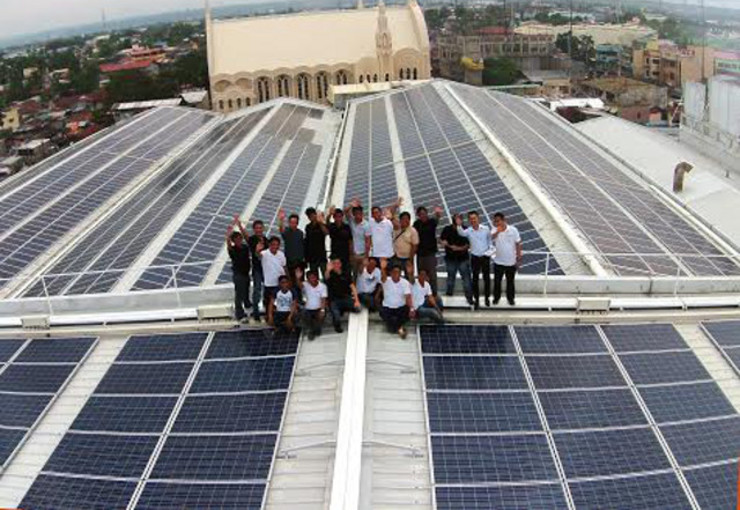
Solar panels will line up roofs of at least 20 malls come next summer, generating about 30 megawatts (MW). 

The  1.5 megawatts of electricity produced by the solar panels at the roof top of SM North Edsa was enough to power 16,000 lighting fixtures and 20 escalators enabling SM to save P2 million per month in electricity bill.

The power generated  from the SM North Edsa  project can offset 1,200 tons of carbon dioxide equal to planting 6,000 trees per year. 

Leandro Leviste, Solar Philippines chief executive officer, said the solar panels in the malls will show people that solar energy is commercially viable. 

“Between Robinsons, SM and some other large malls we should have around 20 malls finished by maybe next summer. The mall installations usually (have a capacity of) 1 megawatt each so I estimate that it would add up to 30 MW,” said Leviste.

He said Solar Philippines is almost done installing the solar power system with a capacity of 2.7 MW on the rooftop of the parking building of the SM Mall of Asia which is targeted to be operational within the month.

“That is more of a showcase to be seen by the millions of people that (frequent) SM Mall of Asia to raise awareness that solar energy is commercially viable. We also have four under construction with Robinsons and many more in the pipeline with them,” Leviste added.

In the past year, among the mall projects completed by Solar Philippines were the 1.5 MW rooftop power plant in SM North EDSA, 1.2 MW in Robinsons Place Palawan, 0.7 MW in Central Mall Biñan in Laguna and 0.6 MW in CityMall Roxas.

Solar Philippines is not yet looking at solar projects in off-grid areas.

“We’re focusing on where we can make the largest impact and scale before going to markets like off-grid and then residential afterwards. Right now, all developers are focused with the feed-in-tariff (FIT),” Leviste said.

Aside from solar rooftop installations, the company is also engaged in the development of various solar power plant projects vying for FIT including the 70 MW in Calatagan, Batangas and a 40 MW solar farm in a still undisclosed area in Mindanao. 

Only energy projects that can produce power before March 2016 can qualify for FIT and become entitled to 20 years of fixed rate of P8.69 per kilowatt hour. 

FIT-certified projects will also be given preference in the dispatch in the Wholesale Electricity Spot Market.

Records of the Department of Energy show as of the first half of the year, the country’s total grid installed capacity from solar projects is at 110 MW or 0.60 percent of the total mix.

Source: http://www.malaya.com.ph/

Tuesday, September 8, 2015

Maganda at Di- Maganda sa Real Estate Investments


Real estate is like gambling - It is suitable for almost everyone and everyone loves it. It gives a better living standard to some and on the other hand the risks take you on a roller coaster ride. It makes or ruins lives. People are skeptical about investing in real estate as they believe that investing in real estate is a sure shot recipe for disaster. But, after careful observation and learning about real estate investments, you might find quite the opposite.


There are both the possibilities with real estate and it depends on many factors. Let me discuss the advantages and disadvantages of this buisness which will give you a better ideas before investing your money.

The advantages of real estate are:-

1. Income stream: - The best way to earn quick money is investing in real estate .It is a secure path to choose which gives you huge benefits. Investment in real estate is good and rental property is in great demand, so through renting property, you can earn money in no time.

2. Secure: - It is very secure to choose real estate because real estate there are not many risks that one needs to handle - like in other businesses .No other business will give that much opportunity.

Investing in real estate is secure because the value does not tend to fluctuate as much as other assets such as stocks and bonds. However, this does not mean that the investor will always break even or earn a profit on their investment. But, the thing about real estate is that once you have a property in hand, you will not need to be worried that its value will change anytime soon.

3. Two ways to earn: - There are two tricks to earn in real estate. As a smart investor, you can own rental houses and rent them out. Then, hopefully you are collecting the differences in your rents and your expenses as profit.

In addition to profiting from renting out your properties, you are also benefiting from its gradual increase in value. So, it is a win-win situation for you at each level.

4. Real Estate Investments are Less Risky: - Without a doubt, real estate is less risky than other investments. Once, the investment done everyone have the fear of losing their money in other businesses. But, real estate investment is a one-time thing which will ensure results even after long periods of time. One just needs patience. Because, the longer you kept your property, the more you will get good amount of benefits and deals. Risk is there in every business. Real estate is less risky because you have to focus on smaller factors which are not at all risky.

The steps which must be follow before investing in real estate:-

Plan it out: - Everything with a plan will always give you a better ideas of benefits.

Suggestion:-Ask for suggestion from an experienced person in real estate investment.

Never hesitate:-Never hesitate to take chances and risk .Because real estate is a game of chances. If you hesitate to take chances you might lose the opportunity to earn big.

Expert advice: -There is always a need to take expert advice before taking any decision. It will always help you to take fast and beneficial decision.

VALUE:-You need to give value to your work money and time. Real estate is based on all of these three factors to get more benefits and earn a good amount of money.

Research:-Before selling or investing in real estate, it's a good idea to search online market about the best value of the place. Do your homework before investing in real estate.

The disadvantages of real estate are:-

Maintenance: - It requires time for maintenance, repair etc. if you have purchased a not so well piece of property. It always seems to be different than what you had planned.
Legal difficulties:-Investing in real estate is easy .But you need to be fully aware about the rules and regulations issued by the government of your country.

3. Property Taxes:-If you want to invest in real estate, taxes is going to be a headache to you. Because the taxes varies on rural and urban areas, it really effects your profit. So awareness about the taxes will be a real life saver.

4. Involvement of Time and money: - Real estate needs a big amount of money for investment and demands attention to property. It sometimes needs more efforts to sell a property with greater benefit. It needs TIME. Real estate Investment is easy to make, but for more benefits and better results it needs your patience. It is sometime costly to manage re-selling and owning a property.

Conclusion: -The only tough part in real estate is that it requires a huge investment of your time and money. Real estate is risky only if you neglect doing a little research on the official government rules and research on the value of your property.

If you want real benefits in real estate, you need to play the game. Every business is like gambling and there is fear of losing. But in this buisness that fear factor is next to nothing and benefits of it are really high. So, make the smart choice and invest in real estate TODAY!
Source: Sooperarticles.com

Friday, March 13, 2015

Manila, Philippines is the best place to be an expat


Forget Singapore, forget Hong Kong. Manila is the best place to be an expat – and 12 expats will tell you why.

We’ve all heard that Manila has increasingly become a center of economic growth and foreign investments, and with great foreign investments come a great number of friendly neighborhood expats. In 2010, the NSO stated that almost 200,000 foreigners were living in the Philippines. Now I don’t know what the current number is, but based on observing the pedestrians of Makati for the past year, I would boldly say that 2 out of 20 pedestrians are probably not Filipino.
A lot of people might ask – why is Manila the best place to be an expat? There are so many opportunities for expats in the urban jungles of Singapore and Hong Kong. Well, we talked to some expats from the Netherlands, from America and even all the way from Colombia who all settled down in the Philippines once they saw the great opportunities here. After reading what they say below, you might be asking yourself – why not Manila?
Jacqueline Van den Ende, Managing Director of Lamudi Philippines
jaq2

Van den Ende, from the Netherlands, arrived in the Philippines in 2013 as the managing director of Rocket Internet’s Lamudi, their online real estate marketplace. Since she’s arrived, she can’t imagine being anywhere else. She often travels around the Philippines and goes surfing for weekend escapes, but loves living in the cosmopolitan city of Manila.
“Manila is a great destination for expatriate employees,” she said. “Cost of living here is not very expensive unlike Hongkong and Singapore, though the city provides a quality of life that’s comparable to Bangkok or Jakarta.”
Van den Ende believes that one of the best attributes of Manila is its openness to different cultures as well. “It will be easy for expats from all types of backgrounds to settle in Metro Manila. Filipinos are world renowned for their hospitality and their friendliness is definitely unlike anything I’ve ever experienced.”
Mauro Cocchieri, Managing Director of foodpanda Philippines
mauro2

Cocchieri comes from Italy, a country known for its great cuisine and accommodating people.He worked at Lazada before becoming the managing director of foodpanda, an online food delivery platform.
Despite his country’s solid culinary reputation, he claims that the Philippines has amazing food and amazing company which goes hand in hand. “The people are very accommodating and they go out of their way to help you. The food, hands down, is one of the best I’ve had.”
Cocchieri, however, cannot help but crave for some homegrown Italian food from time to time. When asked if he often orders through foodpanda he said, “Of course! With my busy schedule, it always pays to have an alternative.”
David Margendorff, Co-Founder & Chairman, PawnHero Philippines
Our third European on the list, Margendorff hails from Germany.
He praises Filipinos for their fun culture and hospitality, but emphasizes that Filipinos are some of the most ambitious and talented professionals he’s ever met. Margendorff is starting PawnHero this year, and he’s chosen Manila as the first city to launch it in. He is currently working with a local team.
PawnHero will be the first online pawnshop in Southeast Asia. Margendorff promises to give Filipinos a cheaper alternative to existing pawnshops which charge extremely high interest rates. “We want to solve the problem of expensive credit for consumers who might not be able to afford it,” he says.
Margendorff has lived in 7 countries for the past 6 years, but he eventually chose to settle in the Philippines. He plans to stay here long-term, mainly because he can see how much impact he can create through PawnHero.
Jimmy Cassells, CEO of Spiralytics
10418896_10152320963594151_7846185975004855560_n
Cassells is from the United States. He’s been in the Philippines since 2005, and he is one of the minds behind the quick growth and expansion of online fashion marketplace Zalora. 2 years ago, he started his own company called Spiralytics, which provides a range of services in digital marketing to some of the biggest brands in the Philippines.
“I love the Philippines!” Cassells begins, “People are so warm, embracing, endearing, and the culture here is wonderful. At work, the team becomes good friends with each other. Everyone definitely feels like they’re part of the ‘barkada.’”
Cassells also exclaims that the tech community here in Manila is exploding with brilliant startup minds. He continues by saying that not all startups are destined for success, but when startups fail, there is still a very low cost of failure when you start in the Philippines. He states, “Failure in the US often means millions of dollars. Here, you can cut that by a factor of 10.”
He also loves the nightlife, the weather, and the beautiful beaches and unlimited dive spots of the Philippines. His favorites include the Tubbataha marine sanctuary, Malapascua for thresher sharks, and Coron for the sunken Japanese WWII warships.
When asked if there was anything else, he said, “Yes! Four months of Christmas which leads up to one of the most amazing fireworks displays in the world. It’s more fun in the Philippines!”
Ezra Ferraz, Chief Content Officer at Zipmatch.com
10961764_438587219624055_840122420_n
Of Filipino heritage, Ferraz taught writing for three years at the University of Southern California and grew up in the US. He moved to the Philippines not very long ago, and writes for Rappler. He currently works at Zipmatch, another online real estate marketplace. He’s interviewed almost every Filipino entrepreneur you can think of, including Erwan Heussaff, and he believes that the Philippines is definitely a great place to pursue business.
Ferraz explains that the entrepreneurial sector in the Philippines is still a small community. “It’s much easier to meet the entrepreneurs changing X industry or Y space because there are relatively few of them, compared to what you might find in another city of similar size.”
“You are never really more than one or two degrees away from someone you’d like to meet,” he adds, “And due to the overwhelmingly friendly culture of the Philippines, other entrepreneurs generally welcome you with open arms.”
Farouk Meralli, CEO of mClinica
unnamed
Farouk Meralli is a 28-year-old Harvard School of Public Health graduate who worked in strategy and management for major pharmaceutical companies Roche, Johnson & Johnson and Pfizer before finally becoming an entrepreneur. He founded mClinica, the largest pharmacy network in the country with a growing network of over 1,400 pharmacies and access to over 20 million customers.
He chose the Philippines as their launch market for mClinica because it provides an interesting test environment for creating truly global products. “The Philippines represents a fascinating intersection between the East and the West. Due to its cultural and political history, one can identify behavioural norms and practices that fit both Eastern and Western paradigm,” he said.
After launching in the Philippines, mClinica is expanding to several emerging markets after leveraging on their experiences in the country. Meralli insists that while he is based in their Singapore headquarters and travelled in many Asian markets, the Philippines is undoubtedly his favorite. To him, it represents the best of both worlds.
Robin Leonard, CEO and Co-Founder of AllFamous Digital
Robin profile pic blue
Five years ago, Robin Leonard moved from New Zealand to the Philippines to start working at IBM before finally starting his own company, AllFamous Digital.
Leonard told us that coming here alone was no problem and not difficult. “Within weeks I had a big group of Filipino and foreigner friends and colleagues that were very welcoming. Culture at work is very family oriented.”
Working culture in the Philippines is not what Leonard is used to back home – and he means this positively.
“Getting people onboard requires one on one lobbying, not big meetings. Laughter is commonplace and gangs or “barkadas” form between staff, often resulting in life-long friendships, which is a good thing. As a foreigner you need to accept that you will sing karaoke, and over time you will learn to give it your all when Hotel California plays.”
According to Leonard, the Philippines also serves as a great place to work because business is done in English. However, he admits that he’s earned a couple of ‘brownie points’ with Filipinos by learning a few keywords in Tagalog.
“It often creates a giggle or surprise if you drop a Tagalog word here and there,” he adds.
Leonard leaves us with a couple of wise words for future expats who want to start their business here: “Crack the big city lifestyle of Manila and you’ll find that it is a gold mine of opportunity, especially for the “expatrepreneur.”
Joost Boer, VP of Operations at Gourmet Society Philippines
Screen Shot 2015-02-09 at 12.01.11
Joost Boer comes from the Netherlands, a country known for its liberal capital Amsterdam, but also widely renowned for its cold, rainy weather throughout the year. After arriving in the Philippines, where there is year-round sunshine, warm people, and a stunning array of islands according to Boer, it’s no wonder that he immediately considered establishing himself here long-term.
“You’ll find no country in Southeast Asia where the culture is so welcoming towards foreigners and where the level of English is this well-developed. From a more business-centric perspective, this has a profound impact on the ease of communication with your co-workers as well as on conducting business development,” he adds.
He continues by praising the business outlook and directional perspective of the Philippines. “Here, you’ll find yourself on an upward curve, and the overall levels of optimism are high. This is a far-cry from life in Europe, where the outlook on life over the years has more and more slanted towards pessimism.
Boer concluded by saying that he strongly recommends his fellow foreigners to consider making the move to the Philippines as well.
Daniel Torres, Managing Director of Easy Taxi Philippines
smart-money---easy-taxi-(2)
Daniel Torres comes from the exciting Latin American city of Bogota in Colombia. He’s been here in the Philippines for a little over a year and he says that Filipinos have been very welcoming since his first day.
“I’ve been amazed and pleasantly surprised by the warmth and helpfulness of Filipinos. Metro Manila has so much to offer in terms of food, cultural diversity and affordable yet high quality living. You’ll always find something new, which makes it a fun city to explore and rediscover.”
Torres also adds that there are a lot of nearby getaways like Puerto Galera, Tagaytay and Sagada, which easily gives people the opportunity to take a break from the fast paced metropolitan.
As the managing director of Rocket Internet’s Easy Taxi Philippines, Torres is happy to contribute to make a better Manila, by improving its transportation system, reducing traffic, and make it safer for everyone.
Henry Keppler, Managing Director of Kaymu Philippines
_DSC0289 copy
Henry Keppler is also from Germany, and he just arrived in Manila a week ago. Although he’s been here very briefly, he already feels that Manila has huge potential for fast growth. Kaymu, launching soon, is another Rocket Internet venture.
Keppler felt the trademark Filipino hospitality. “I immediately felt connected to locals. Their genuine openness and interest in what I do and why I’m here pleasantly surprised me. Compared to other Asian countries, they are very open!”
Launching new ventures may be difficult to do in a new country, especially when it is critical to have low resistance from potential customers. Keppler feels that Filipinos are willing to try out new products, and he is definitely excited to learn more about the city and its different characteristics.
Dip Ghuman, CEO of Near
IMG_5231
Dip Ghuman worked at Google and Lonely Planet before joining the entrepreneur world. He believes the Philippines market is a sleeper – slowly building steam, quietly, ready to pounce on an unsuspecting world economy.
“With the world so focused on Silicon Valley, China, Japan, Europe, etc – no one is looking at the Philippines. Here’s why they should,” he begins.
According to Ghuman, one of the first things that caught his attention about the Filipino market was that 60% of the population in the Philippines is younger than 20 and that was coupled with GDP growth of 6%+ YoY. Because of these facts, he views the Philippines as a representation of the next financial boom in Asia.
“There is a growing Westernized middle class who speaks perfect English, and this makes the country an ideal springboard to launch your business in Asia. Barring corruption, the Philippines has a small window of opportunity to return the country to its pre-World War 2 status as the ‘Pearl of the Orient,’” Ghuman adds.
Ghuman says that he’s started two businesses within two years, the latter of which is launching in March 2015 in Manila. “I got on that plane a year and a half ago to start my California wine business, but now I’m focusing on a new hyperlocal mobile messaging app, Near.”
Ghuman concludes, “Manila is the social media and selfie capital of the world – there is nowhere better for me to be than right here, right now.”
Bryce Maddock, CEO of TaskUs
BryceMaddockresized
Bryce Maddock arrived in Manila in 2009 from the United States. He had just started TaskUs and was determined to connect rapidly growing American startups with incredible talent at prices that would enable them to scale. He found what he was looking for in the Philippines.
“When we just started TaskUs, I wouldn’t have been able to find the Philippines on a map if you asked me. We went on a search for affordable talent to support our friends’ startups. We hired people in 16 different countries, but were consistently impressed by the results and work that Filipinos were delivering. We were so impressed, that we opened our first office here, in Bacoor, Cavite and have not looked back since.”
Today, Maddock has 1,600 employees and counting. TaskUs is the secret behind the rapidly growing customer support and back office operations for startups like Tinder and HotelTonight.
“Almost all of today’s most successful startups depend on the talent that exists in the Philippines. Simply put, it’s the people. The people of the Philippines are some of the kindest and most talented people on the planet. Historically, the country exported its people as OFWs. But today a homecoming is happening,” says Maddock. “The next decade is going to be very exciting as talent repatriates and reinvests in the country.”
It’s time for the balikbayan to come back for good.
One of the Philippines’ biggest exports is its own people. Everyone was leaving to work abroad because they believed there was no opportunity for them here. All that amazing talent went into making prosperous countries even more prosperous.
Today, we should acknowledge that that is no longer true. The best opportunities for business are here in the Philippines. Foreigners are flocking here to start their businesses in the perfect Asian beta market. They happily leave their first world countries for what the Philippines has to offer.
We, as Filipinos, should all find it in ourselves to see the beauty of our country the way they do; to finally discover the diamonds that have been waiting to be found for decades.
SOURCE: https://www.kalibrr.com/advice/2015/02/why-manila-is-the-best-place-to-be-an-expat/